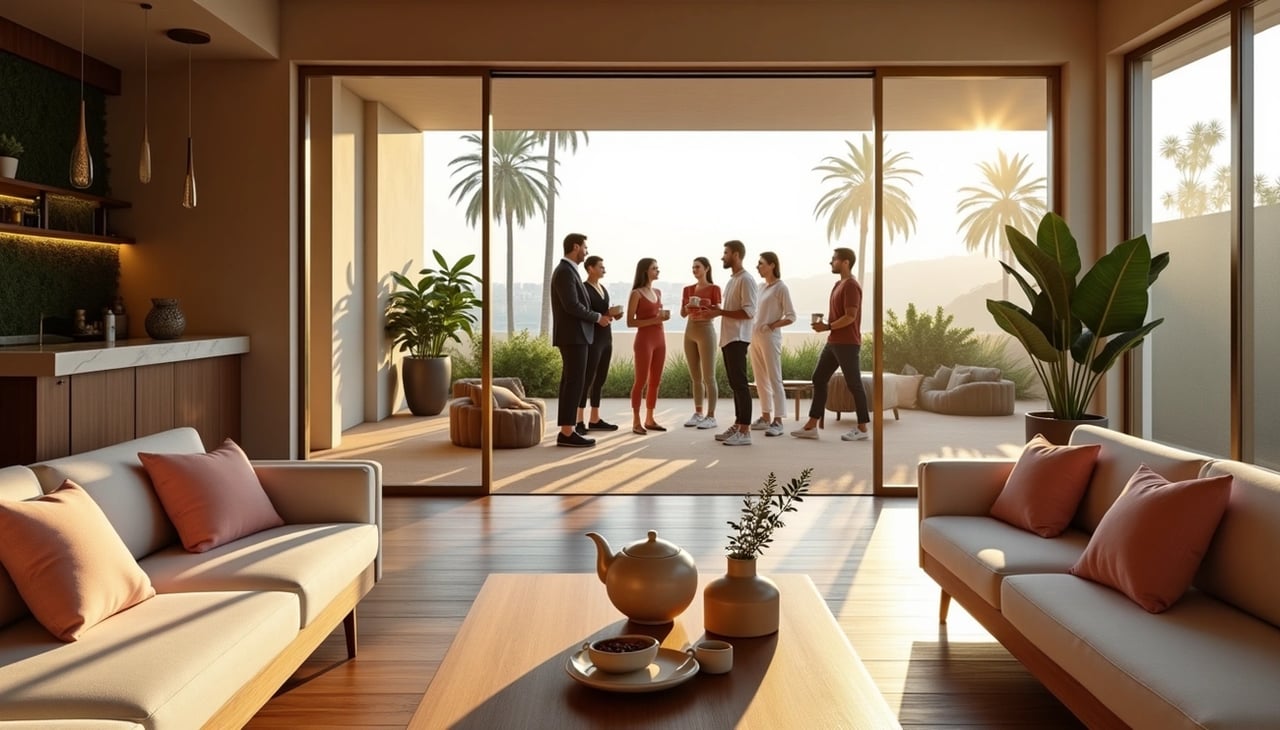
Alo Yoga community events have quietly become gathering grounds for LA's luxury buyers, replacing country club mixers and traditional networking venues. The wellness brand's studios now host the same high-net-worth individuals who once conducted business over golf and martinis. Cigna's 2025 report reveals that 67% of Gen Zers and 65% of millennials report feeling lonely, which explains the surge in demand for meaningful in-person connections. Remote work patterns intensified this need for physical community spaces. The wellness industry recognizes this opportunity, with the global wellness market expected to reach nearly $10 trillion by 2030. Los Angeles real estate professionals who understand where affluent clients spend their time gain valuable insight into community development patterns and luxury market behavior.
The evolution of luxury social spaces in Los Angeles
From country clubs to wellness communities
Country clubs built their appeal on golf courses, poolside gatherings, and refined dining facilities. Business deals happened between rounds while families bonded over weekend tournaments. Fitness centers existed as afterthoughts, secondary to the club's social architecture.
Wellness communities operate under different principles entirely. Clubs like Remedy Place and Heimat position themselves as private social sanctuaries where fitness, recovery, and community converge under one roof. Heimat occupies a former record-pressing plant in Hollywood, charging $350 monthly for access to five floors of Pilates studios, saunas, meeting spaces, and dining options. Members spend entire days there, taking classes, conducting business, and forming relationships without battling Los Angeles traffic.
Love.Life takes this integration further. The club combines state-of-the-art fitness facilities with diagnostic testing, personalized medical care, and preventive health measures. Members can designate the club's physicians as their primary care providers, effectively blending wellness with healthcare delivery.
Why traditional networking venues are losing appeal
Millennials drive the shift away from sport-centric country clubs toward members-only social clubs that accommodate varying interests and active lifestyles. The golf-focused model fails to align with how younger affluent professionals want to spend their time or conduct business. They value experiences and expect spaces that support both work and play.
Cultural messaging has shifted completely. Business meetings now happen in meditation rooms rather than on fairways. Deals close over green juices instead of martinis. Friendships form in cold plunges. This represents a fundamental reorientation around productive social time.
Third spaces as the new status symbol
Ray Oldenburg coined "third places" in 1989 to describe spaces between home and work where people gather informally. Wellness clubs now represent this concept's premium evolution, where membership signals health prioritization and access rather than traditional social status markers.
Equinox chairman Harvey Spevak stated that "health is the new luxury." This sentiment captures how wellness investments have become signature amenities, carrying equivalent weight to golf courses for prospective members during facility tours. These clubs function as the new office, the new happy hour, and the new weekend ritual combined into one ecosystem.
Alo Yoga's blueprint for building loyal communities
Studio locations and class offerings
Alo positions its retail locations as "sanctuaries" rather than stores. These spaces integrate shopping with yoga studios, meditation areas, and wellness cafés under one roof. The brand hosts up to 90 events monthly, ranging from yoga classes to virtual gatherings and retreats. Each sanctuary functions as both retail environment and community hub, hosting regular workshops that position Alo as a lifestyle facilitator.
The Alo Moves platform extends this physical presence into subscribers' homes. With over 2 million active users as of 2024, the digital platform offers workout videos, instructor connections, and community challenges. Members enter through product purchases and stay for daily routines that structure their mornings and evenings.
Sound baths, breathwork, and recovery experiences
Sound healing anchors alo yoga community events. Susy Markoe Schieffelin, an LA-based sound healer and reiki master, leads sessions using crystal singing bowls and gongs. These high-frequency instruments activate chakras and stimulate alpha, theta, and delta brain wave states. Participants report relief from chronic pain, improved sleep, and reduced anxiety after single sessions. Regular attendees experience more profound shifts: better focus, enhanced memory, and healing of autoimmune conditions over months of attendance.
Creating belonging without alcohol
The wellness model removes alcohol from social interactions completely. Members connect through shared movement practices, recovery sessions, and mindful activities. This approach reflects the growing trend of alcohol-free social spaces, where people seek companionship without hangovers or pressure to drink. The format attracts both those in recovery and the sober-curious.
The pricing model and member retention
Alo builds loyalty through sustained relationships rather than one-time transactions. The brand's global retreat program serves as the ultimate experience, combining luxury travel with wellness immersion. Participants become ambassadors, sharing experiences across social platforms and reinforcing the brand's premium positioning organically.
Where LA's affluent residents are gathering now
Wellness-focused third spaces across LA neighborhoods
Love.Life commands 45,000 square feet in El Segundo, where medical care meets luxury fitness under one roof. Members work with dedicated physicians who serve as their primary care providers, essentially redefining what a wellness club can offer. The facility provides specialized diagnostic testing, preventive health protocols, and nutrition programs focused on longevity.
Artha operates in Studio City and West LA, offering everything from yoga and mat Pilates to HIIT classes alongside recovery therapies like customized massages, infrared saunas, and cryotherapy. Pause Studio specializes in contrast therapy, alternating between cold plunge and infrared sauna sessions, plus private float tanks with mineral-rich water. Hume in Venice Beach combines marble soaking tubs with natural light, reformer Pilates studios, saunas, steam rooms, and rooftop social gardens.
The business model works. Bathhouse in New York expects $120 million in run rate revenue with approximately 1,000 daily customers across two locations, even with drop-in sessions starting at just $40.
Creative studios and collaboration spaces
FEYBL caters to artists, filmmakers, and entrepreneurs with private studios, shared workspaces, complimentary parking, and late-night access. ROW DTLA converts century-old buildings into integrated work-culture-play districts, featuring creative offices with natural light, lofted ceilings, exclusive athletic clubs, and regular community events.
Members-only clubs vs accessible community hubs
Members-only clubs have shifted their focus, prioritizing exclusivity through experience rather than traditional gatekeeping. The most successful private clubs concentrate on real estate quality over membership numbers, creating exceptional spaces in prime markets where the properties themselves drive value. Accessible hubs take the opposite approach, emphasizing drop-in flexibility and spontaneous membership opportunities.
The role of spontaneous connection in luxury spaces
Thoughtful design encourages natural interactions through shared activities and communal spaces where members participate in collective experiences rather than isolated pursuits.
How Los Angeles real estate values track community development
Premium local amenities directly influence property valuation, determining neighborhood appeal and guiding buyer preferences.
Christina Pope, Sotheby's International Realty | EliteResidenceInternational.com
The business case for third spaces in luxury markets
Los Angeles Real Estate luxury transactions unfold through private channels where discretion matters as much as valuation. The most significant deals happen within trusted networks, guided by professionals who understand that timing and access determine outcomes. Third space investments follow this same principle, where financial performance depends on carefully constructed community economics rather than public visibility.
Revenue models: Memberships, drop-ins, and events
Third Space in the UK shows the financial structure works: revenue grew 40%+ year-over-year while profits more than doubled. Memberships ranging £200–£400 monthly generate recurring revenue with pricing power. Members don't simply work out; they arrive, work, socialize, and practice recovery, creating higher dwell time and multiple revenue streams per person.
The optimal mix balances 75% members with 25% drop-ins. Members deliver up to 8x more repeat visits, whereas drop-ins provide higher per-class fees and fill capacity gaps. Some establishments generate $100,000+ monthly from membership programs alone. Bathhouse expects $120 million in run rate revenue with 1,000 daily customers.
Why brands are investing in physical community spaces
Emotional switching costs prove more valuable than transactional relationships. Physical spaces create feelings that affect emotions long after visitors leave. Brands no longer need traditional advertising when customers belong to engaged communities. Sixty-six percent of brand community members demonstrate loyalty to the brand.
Real estate implications for developers and investors
Landlords contribute millions to capital expenditures because third spaces rebrand entire developments. While retail fights footfall, third spaces win daily intentional visits. Over half of renters prioritize location over unit quality, and 91% of Urban Land Institute members agree arts and culture add value to real estate projects.
Christina Pope, Sotheby's International Realty | EliteResidenceInternational.com
Conclusion
Third spaces have fundamentally changed how affluent Angelenos build relationships and conduct business. The movement away from country clubs toward wellness communities reveals new cultural priorities around health, authentic connection, and purposeful living. Real estate professionals and developers who understand this shift position themselves ahead of market trends. Properties near established wellness hubs now command premium valuations, much like golf course proximity once determined desirability. Early recognition of this pattern creates strategic advantages within LA's luxury market evolution.
Key Takeaways
LA's luxury buyers are abandoning traditional country clubs for wellness-focused third spaces, fundamentally changing where high-net-worth networking and relationship-building occurs.
• Wellness communities replace country clubs: Affluent Angelenos now gather at spaces like Alo Yoga, Remedy Place, and Heimat, where business deals happen in meditation rooms instead of golf courses.
• Third spaces drive real estate values: Properties near high-quality wellness hubs command premium valuations, with 91% of developers agreeing these amenities add significant value to developments.
• Revenue models prove highly profitable: Successful wellness clubs generate $100,000+ monthly from memberships alone, with 75% recurring members creating 8x more repeat visits than drop-ins.
• Community beats transactions: Brands investing in physical spaces create emotional switching costs and loyal communities, with 66% of members demonstrating long-term brand loyalty.
• Alcohol-free networking thrives: Modern luxury social spaces eliminate alcohol entirely, attracting both sober-curious individuals and those seeking authentic connections through shared wellness experiences.
This trend represents more than a lifestyle shift—it's a fundamental reorientation of how luxury markets operate, where health becomes the new status symbol and community membership drives both social capital and real estate investment decisions.
FAQs
Q1. Is Alo Yoga positioned as a luxury wellness brand? Yes, Alo Yoga operates as a premium wellness brand that positions its retail locations as "sanctuaries" rather than traditional stores. These spaces integrate shopping with yoga studios, meditation areas, and wellness cafés, hosting up to 90 events monthly. The brand's global retreat program and community-focused approach place it firmly in the luxury wellness category, attracting affluent consumers who prioritize health and authentic connection.
Q2. Who owns and operates Alo Yoga? Alo Yoga was co-founded in 2007 by Danny Harris and Marco DeGeorge, who continue to own and run the company through Color Image Apparel. Their pre-existing manufacturing infrastructure through Bella+Canvas provided Alo with an operational foundation that most new brands don't have access to, contributing to their ability to scale both physical and digital community offerings.
Q3. How can someone become an Alo Yoga influencer? To join Alo Yoga's influencer program, visit their official website and complete the application form. You'll need to provide your social media handles, follower count, and a description of your content style. Before submitting, it's beneficial to actively engage with Alo Yoga's social media accounts to demonstrate genuine interest in the brand and its wellness community.
Q4. Why are wellness clubs replacing traditional country clubs in Los Angeles? Wellness clubs align better with how younger affluent professionals want to spend their time and conduct business. Unlike golf-focused country clubs, wellness communities like Remedy Place and Heimat offer integrated experiences combining fitness, recovery, and networking without requiring hours on the golf course. Business meetings now happen in meditation rooms, deals close over green juices, and friendships form in cold plunges, reflecting a fundamental shift toward health-focused social interaction.
Q5. How do third spaces impact Los Angeles real estate values? High-quality wellness amenities function as pivotal factors in property valuation, with 91% of Urban Land Institute members agreeing that these spaces add significant value to real estate projects. Properties near premium wellness hubs command higher valuations, similar to how golf course proximity once drove desirability. Landlords often contribute millions to capital expenditures because third spaces can rebrand entire developments and generate daily intentional visits rather than occasional foot traffic.