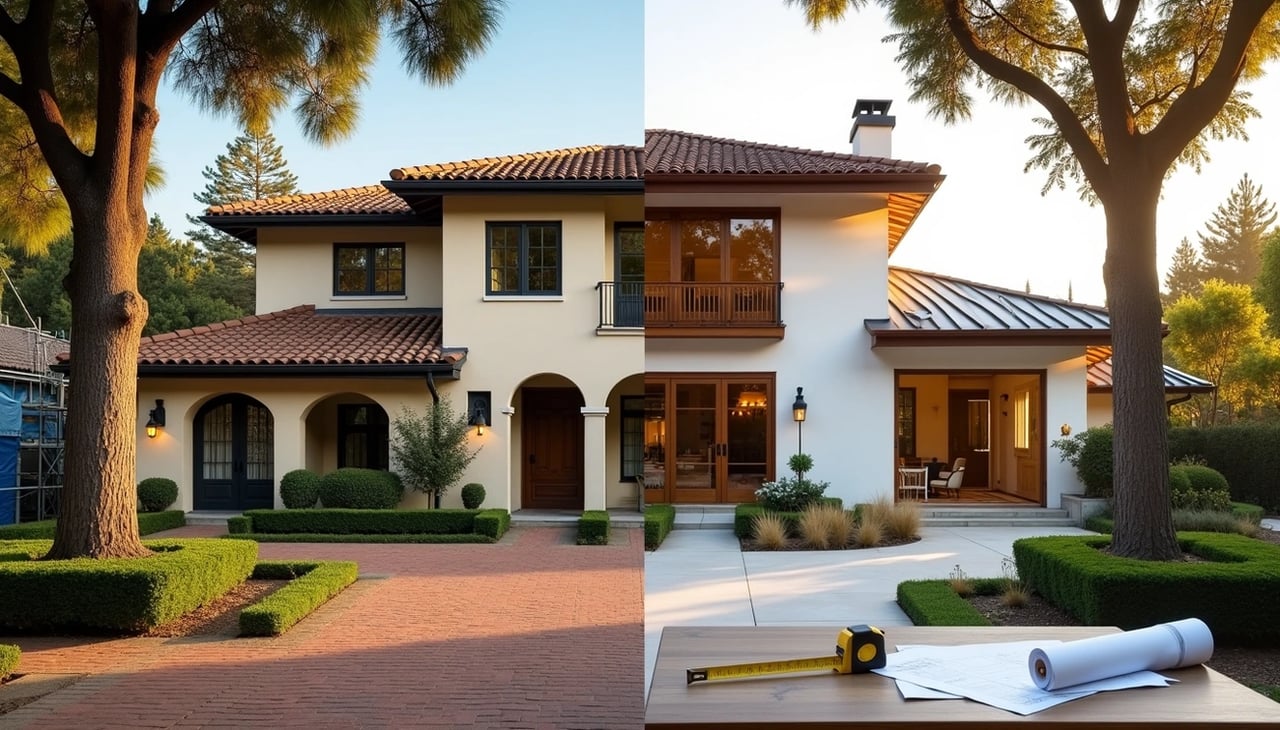
Rebuilding a house has become a strategic choice in Brentwood's luxury real estate market, where decisions unfold through private conversations rather than public listings. As a matter of fact, 9.1 percent of new single-family homes nationwide are built in older neighborhoods after tearing down and rebuilding a house on the same site. This decision carries weight for Brentwood estate owners. Historic properties, including the iconic Marilyn Monroe house Brentwood residents recognize, highlight the preservation debate. At the same time, most full-scale renovations take 6-12 months and encounter permitting complexities specific to the area. This piece gets into when demolishing and rebuilding a house offers more control than renovation, the cost of rebuilding a house in premium markets and how to assess which path maximizes long-term value.
Understanding Your Property's Potential: Renovation vs Demolishing and Rebuilding a House
Property evaluation in premium markets requires exploring factors that determine whether tearing down and rebuilding a house makes financial sense compared to renovation. Professional structural inspections reveal the true condition of foundations, walls and support systems before committing to either path.
Assessing Current Structure and Systems
Structural engineers get into load-bearing components and identify issues that affect project viability. Foundation problems, compromised support beams or extensive water damage can move the equation toward rebuilding. Older estates often contain hazardous materials such as asbestos, lead pipes or outdated wiring that require expensive remediation before renovation work begins.
Moisture intrusion creates long-term safety hazards that weaken structural integrity over time. Hidden deterioration in joists, subfloors or framing may not surface until walls open during construction. Cosmetic finishes conceal settlement repairs, framing alterations or movement that contractors verify through field inspection rather than relying on past permit drawings.
Renovation costs range between $15 to $60 per square foot for whole-house remodels. But when repair expenses exceed 50% of the property's market value, demolishing and rebuilding a house becomes the more sound financial decision. New construction costs run $150 to $400 per square foot, with demolition adding $4 to $10 per square foot depending on structural complexity and debris removal requirements.
Evaluating Lot Maximization Opportunities
Zoning regulations determine whether properties can expand square footage or require special approvals that extend timelines. Some municipalities protect older homes from demolition through historical preservation requirements, while others impose size and placement restrictions on new construction.
Properties with inefficient layouts that require substantial structural changes benefit more from complete rebuilds. The cost to tear down a house and rebuild unlocks design flexibility that renovations cannot match when working around existing load paths and room configurations.
Market Positioning for Resale
Buyer priorities shape which approach delivers stronger returns. New construction commands premium pricing over renovated properties, especially when featuring modern amenities and energy-efficient systems. Rebuilds maximize land value that often exceeds the structure's worth in high-growth areas. Properties with unique architectural details may warrant preservation and attract buyers who value character, though this depends on neighborhood trends and comparable sales data.
The Hidden Realities of Renovating Brentwood Classic Estates
Estate renovations reveal their true complexity once construction begins. Permitting processes in municipalities can extend timelines substantially, with some jurisdictions requiring 60 days or more for approval. Review cycles for architectural changes add layers of oversight that delay material orders and contractor schedules, especially in older neighborhoods. Failed inspections trigger corrections and re-inspections that compound time losses.
Permitting Delays and Review Processes
Building departments face backlogs during construction booms. Standard two-week residential permit approvals stretch into months. Architectural review boards get into exterior modifications with scrutiny that affects project momentum. Each revision request resets the clock while contractors maintain crews on standby at added expense.
Design Constraints from Existing Structure
Load-bearing walls dictate room layouts that limit open floor plans. Structural modifications require beam installations and column placements or foundation reinforcements that reduce usable space. Electrical, plumbing and HVAC systems embedded in walls create obstacles when relocating fixtures or expanding rooms. Ceiling height minimums prevent certain modifications when existing clearances meet code requirements just enough.
Unexpected Discoveries During Construction
Opened walls expose conditions invisible during inspections. Plumbing that fails current code standards, undersized electrical panels, water damage and structural deterioration from moisture exposure surface mid-project. These discoveries demand remediation right away that halts other trades and extends schedules.
Budget Escalation Patterns
Remodeling projects exceed original expectations due to scope changes and unforeseen conditions rather than material costs alone. Property owners should include a 10-20% contingency buffer for hidden issues. Kitchen and bathroom renovations carry the highest risk because multiple systems intersect in confined spaces, where one delay affects several components at once.
Compromises That Affect Final Outcome
Budget pressures force decisions between structural necessities and finish priorities. Homeowners cap plumbing and electrical rough-ins and postpone fixture installations until funds allow. Temporary solutions replace permanent upgrades. Design files help prioritize spending, though most buyers cannot afford everything on their original vision list.
Why Tear Down House and Rebuild Offers More Control
Ground-up builds provide control that renovations cannot match. Owners get control over layout, materials, mechanical systems and energy performance when they replace site infrastructure and the whole building envelope. Cleared land eliminates compromises that come with working around existing structures.
Complete Design Freedom and Customization
Blank sites allow designers to specify nearly every dimension of the home. This includes footprint, flow, ceiling heights and mechanical layouts. Bespoke layouts become straightforward without load-bearing walls dictating room placement or existing foundations limiting expansion. Owners specify high-efficiency HVAC, whole-house automation during rough-in and modern material assemblies that meet current energy standards. Structural constraints force design adjustments and make this level of customization difficult.
Modern Building Standards and Safety Codes
Pennsylvania's updated Uniform Construction Code goes into effect January 1, 2026. It adopts the 2021 International Code Council building codes. New construction meets these standards right from the beginning and incorporates updated requirements for building envelope performance, mechanical system efficiency and lighting design. HVAC equipment must satisfy updated efficiency standards. Systems are sized and controlled to meet new performance requirements. Buildings perform better over their lifetime and meet modern expectations for occupant safety, though this affects costs upfront.
Energy-Efficient Systems from the Ground Up
Modern assemblies designed to current standards deliver higher baseline efficiency. Mechanical systems sized to modern standards during construction often reduce operating costs versus older homes. High-performance insulation, triple-glazed windows and renewable energy heating systems integrate easily during construction. Air-source heat pumps can be added at this stage as well. These energy upgrades cut down operational costs over 20-30 years.
Predictable Timeline and Budget Management
New construction follows a linear design, permit and build flow with coordinated phases: site work, foundation, framing, enclosure, rough-ins and finishes. Estimates become more reliable once plans and site studies finish. Builders sequence tasks in order and avoid reactive adjustments while they maintain steady workflow. Owners can plan temporary living arrangements with greater confidence because of this stability.
The Cost of Rebuilding a House: Investment Analysis for Brentwood
Financial analysis separates rebuilding a house speculation from sound investment. Demolition costs in most markets fall between $4 and $17 per square foot. A 1,500-square-foot home requires $7,000 to $15,000 for simple teardown. Larger properties or complex layouts push expenses toward $25,000 to $50,000. Hazardous materials add $1,170 to $3,120 for asbestos abatement, with rates spanning $5 to $20 per square foot depending on location and extent. Permits range from $1,500 to $10,000. Site preparation adds $5,000 to $15,000.
Demolition and Site Preparation Expenses
Property owners face utility disconnection and debris removal beyond tearing down house structures. They also need temporary fencing. Full demolition averages $8,000 to $20,000. Deconstruction for material salvage reaches $10,000 to $50,000.
New Construction Costs Per Square Foot
New builds run $150 to $400 per square foot nationally. The median sits at $166 for spec homes and $180 for custom designs. The Pacific region, including California, commands $223 per square foot for spec homes and $250 for custom construction. Premium builds exceed $2,800 per square meter. Luxury projects climb past $4,000.
Return on Investment in Premium Markets
Well-executed rebuilds generate 10 to 20 percent immediate equity upon completion. Modern homes appreciate faster than renovated properties in markets where land value exceeds structure worth.
Financing Options for Rebuild Projects
Construction-to-permanent loans convert to standard mortgages after completion. Home equity loans and HELOCs utilize existing property equity. Christina Pope would be delighted to help you find spaces designed for raised living and effortless hosting if you're beginning your search. Christina Pope  310-404-9931
  [email protected]
Conclusion
Rebuilding versus renovation requires more than budget analysis. Structural constraints and permitting complexities determine which path delivers better returns. New construction offers predictable timelines and design freedom that renovations cannot match, especially when hidden conditions escalate costs mid-project. To entertain guests, the right home matters, and Christina Pope would be happy to help find spaces designed for raised living at 310-404-9931 or [email protected].
Key Takeaways
When renovation costs exceed 50% of your property's market value, rebuilding becomes the smarter financial choice for long-term returns.
• Rebuilding offers complete design freedom - Start from scratch to create modern layouts without structural constraints that limit renovations.
• Hidden renovation costs escalate quickly - Unexpected discoveries like water damage, outdated systems, and code violations can double initial budgets.
• New construction provides predictable timelines - Linear build phases avoid the delays and surprises common in renovation projects.
• Modern builds command premium pricing - Ground-up construction with energy-efficient systems and current codes delivers 10-20% immediate equity.
• Demolition costs are manageable - At $4-17 per square foot, teardown expenses represent a small fraction of total rebuild investment.
In Brentwood's luxury market, where 9.1% of new homes are built after demolition, rebuilding maximizes both property value and owner satisfaction compared to working within the constraints of aging structures.
FAQs
Q1. Is it more cost-effective to renovate an existing home or rebuild from scratch? When renovation costs exceed 50% of your property's market value, rebuilding typically becomes the smarter financial choice. New construction costs range from $150 to $400 per square foot, while whole-house renovations run $15 to $60 per square foot. However, renovations often encounter hidden issues like structural damage, outdated systems, and code violations that can double initial budgets, making the final cost comparable to or higher than rebuilding.
Q2. What are the main advantages of tearing down and rebuilding versus renovating? Rebuilding offers complete design freedom without structural constraints, predictable timelines with linear construction phases, and modern building systems that meet current energy efficiency and safety codes. You can customize every aspect from the ground up, including layout, ceiling heights, and mechanical systems. New builds also typically command premium pricing and generate 10-20% immediate equity upon completion.
Q3. What hidden costs should I expect during a major renovation project? Renovation projects frequently reveal unexpected issues once walls are opened, including water damage, outdated electrical panels, undersized plumbing, asbestos, and structural deterioration. These discoveries require immediate remediation that halts other work and extends schedules. Property owners should include a 10-20% contingency buffer in their budget, as most projects exceed initial estimates due to unforeseen conditions rather than just material costs.
Q4. How much does it cost to demolish a house before rebuilding? Demolition costs typically range from $4 to $17 per square foot. A standard 1,500-square-foot home requires $7,000 to $15,000 for basic teardown, while larger or more complex properties can reach $25,000 to $50,000. Additional expenses include hazardous material abatement ($1,170 to $3,120 for asbestos), permits ($1,500 to $10,000), and site preparation ($5,000 to $15,000).
Q5. Should I keep my low mortgage rate and renovate or sell and buy a move-in ready home? This decision depends on multiple factors beyond interest rates. Consider your neighborhood satisfaction, the scope of needed repairs, and whether renovation costs align with neighborhood property values. If your home needs extensive structural work (foundation, roof, systems), the hassle and unpredictability of renovation may outweigh the benefit of keeping a low rate. However, if you love your location and neighbors, renovating allows you to create a customized home while maintaining those valued aspects.